The Modernization Moment: Empowering Infrastructure for Real-world AI

The tech industry’s embrace of AI borders on obsession, and for good reason. Its transformative potential is reshaping how businesses grow, innovate, and operate at every level. Yet beneath this wave of innovation lies a quieter challenge: enterprise systems weren’t built for this kind of acceleration. As GenAI becomes mainstream, many organizations are realizing their existing infrastructure can’t keep pace with its scale or complexity. Most AI applications still run on traditional IP-based architectures that are reliable for conventional workloads and for experimenting with AI but not optimized for AI’s massive data movement, scalability, and performance needs. It’s like driving a race car stuck in first gear, moving forward but not at the speed one desires.
Key Takeaways
- Most enterprise infrastructure was not built for AI workloads. Seventy-six percent of organizations already use GenAI. Only 53% feel confident their infrastructure can support it. Legacy systems struggle with AI’s data movement, scalability, and performance demands.
- The infrastructure gap is real and measurable. Only 19% of organizations have implemented automated scaling. Security, scalability, and performance are the top pain points, cited by 49%, 38%, and 38%, respectively, of organizations.
- Seventy-nice percent of organizations plan to modernize infrastructure within the next 18 months. The shift is from experimentation to execution. Early movers can deploy AI faster, protect data at scale, and ensure availability across hybrid environments.
- AI infrastructure modernization focuses on three areas: networking, hybrid cloud, and security. High-performance load balancing reduces latency. Hybrid cloud enables workload flexibility.
The AI-infrastructure Imbalance
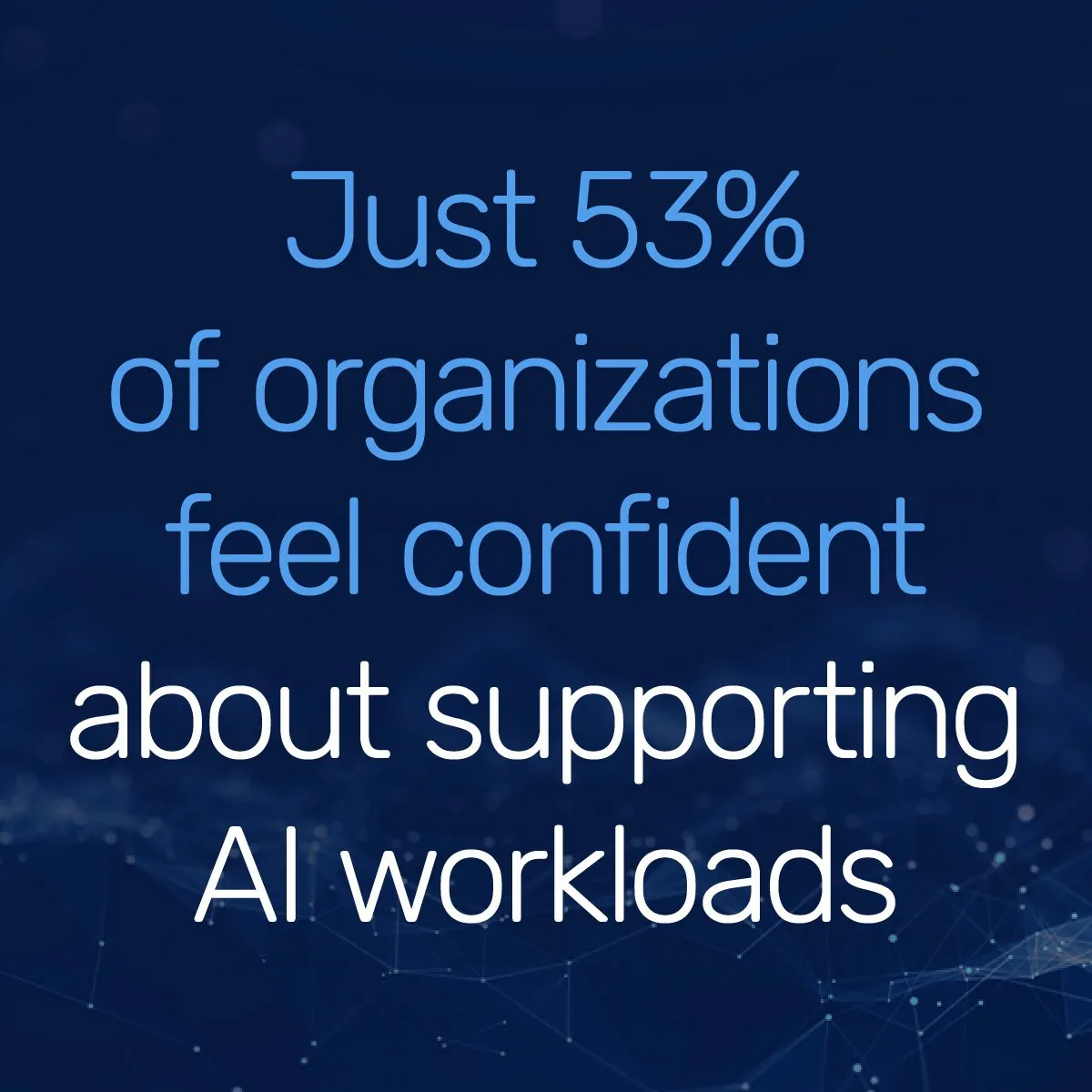
The rise of AI rise has been meteoric, but the infrastructure meant to support it is still catching its breath. The new State of AI Infrastructure Report 2025 lays it bare. While 76 percent of organizations are already using GenAI, only 19 percent have implemented automated scaling, and just 53 percent feel confident in their ability to support future AI workloads. Security, scalability, and performance top the list of pain points at 49 percent, 38 percent, and 38 percent, respectively.
Legacy systems built for predictable, transactional workloads now struggle with the dynamic data-hungry demands of AI. As AI models grow more complex and data flows multiply, enterprise networks need to scale smarter, secure faster, and perform consistently across hybrid environments. It’s time to trade yesterday’s infrastructure for one built for real-world AI.
The Modernization Moment
The widening gap between AI adoption and infrastructure readiness presents not just a challenge, but a defining opportunity. The A10 State of AI Infrastructure Report 2025 reveals that 79 percent of organizations plan to modernize their infrastructure within the next 18 months, signaling a decisive shift from experimentation to execution.
Forward-looking enterprises see modernization as momentum over maintenance. Modernizing now gives them the edge to run real-world, AI-powered applications with the speed, scalability, and security they demand. By rearchitecting for performance, visibility, and automation, early movers can deploy AI faster, protect data at scale, and ensure continuous availability across hybrid and multi-cloud environments. The real competitive advantage isn’t in catching up, it’s in being ready.

What Modernization Looks Like
Modernization isn’t just about new technology; it’s about integration: unifying performance, scalability, and protection across hybrid environments to create AI-ready infrastructure that evolves at the pace of innovation itself. Organizations currently in the modernization planning stage, as identified in the survey, are focusing on three critical fronts:
- Infrastructure: Enterprises are modernizing with high-performance networking, intelligent load balancing, and edge computing that brings compute closer to data. This reduces latency, improves uptime, and supports the dynamic scaling that AI-driven applications demand.
- Hybrid Cloud: Modernizing hybrid environments is about agility, i.e., creating flexible architectures that allow workloads to move effortlessly between on-prem and hyperscalers. Enterprises optimizing for scalability, visibility, and automation are using hybrid cloud models to strike the right balance between control and speed. The goal: consistent performance, wherever AI-powered applications run.
- Security: Security remains the cornerstone of modernization. Nearly half of organizations that responded to the survey cite it as their top infrastructure challenge, yet only 40 percent have implemented AI-specific protections. The focus is shifting towards solutions built to understand and protect AI data flows without slowing them down, such as AI-aware firewalls, API security, Zero-trust frameworks, and DDoS defenses.
The A10 Perspective: Enabling an AI-ready Hybrid Infrastructure
Bridging the gap between AI innovation and infrastructure readiness requires a new kind of foundation, one that is secure, scalable, and built to perform across hybrid and multi-cloud environments. A10 enables this evolution through AI-aware security, high-performance networking, and intelligent automation that brings resilience and agility to every layer of the infrastructure stack. With AI-specific protections such as adaptive firewalls, API and DDoS defense, and Zero-trust frameworks, enterprises can secure data wherever it flows. At the same time, smart traffic management and dynamic load balancing ensure AI applications scale effortlessly across hybrid environments. By uniting security, performance, and manageability, A10 helps organizations create an AI-ready hybrid cloud foundation that doesn’t just catch up with AI innovation; it propels it forward.
FAQs
AI requires infrastructure built for dynamic scaling, low latency, and massive data movement. Modernizing with intelligent load balancing, hybrid cloud architectures, and automated scaling allows organizations to deploy AI workloads faster and more reliably.
Legacy systems were built for predictable, transactional workloads. AI demands dynamic scaling, real-time data processing, and high throughput. Modernized infrastructure with high-performance networking and hybrid cloud models enable consistent performance across complex AI workloads.
The most widely adopted solutions include intelligent load balancing, hybrid cloud environments, AI-aware security frameworks, and automated traffic management. These enable organizations to scale AI workloads efficiently while maintaining security and performance across hybrid cloud environments.
Real-time infrastructure reduces latency and ensures continuous availability. Bringing compute closer to data through edge computing and dynamic load balancing allows AI applications to respond faster, scale seamlessly, and deliver consistent performance to end users.