Enterprise AI Safety Reimagined: Setting the Standard for Safe and Robust LLM Protection

A10 Networks is redefining enterprise perceptions of its security and AI safety capabilities, positioning us as an industry leader in safeguarding AI-driven applications and large language models (LLMs).
AI Security Leadership and Layer 8 Innovation
We have a robust track record in securing top cloud providers and delivering API protection at scale, demonstrating recognized low-latency performance across major data centers. A10’s innovation accelerated with “Layer 8,” which addresses human intent expressed in user prompts and deploys advanced LLM expertise in cybersecurity contexts.
Frameworks: OWASP Top 10, NIST and MITRE
Enterprises deploying AI must confront substantial risks. A10 is committed to adhering to guidelines and frameworks that support robust security operations, including the OWASP Top 10 for LLMs and best practices from NIST and MITRE Atlas. These references form the foundation for enterprise AI governance and safety, focusing on prompt injection, insecure output handling, training data poisoning, and the prevention of sensitive information leaks.
Securing Internal and Public LLMs
Organizations use both internal (private) and public LLM-powered applications, each requiring robust technical controls to prevent the exfiltration of personally identifiable information (PII) and other sensitive data. Enterprises should be looking for low-latency protection across APIs, public internet endpoints, and LLM interfaces, enabling real-time detection and mitigation of prompt attacks and data leakage.
Enterprise Realities and Safety Guardrails
Our customer conversations reveal several priorities that go beyond academic recommendations:
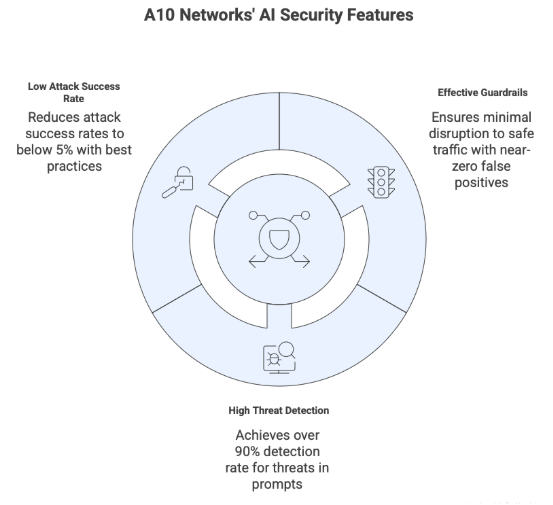
- Guardrails must be highly effective and minimize the disruption of safe traffic: They should strive for a near-zero false-positive rate for prompt jailbreaking, personally identifiable information detection, and toxicity—far surpassing typical industry benchmarks.
- High threat detection rates: They should be engineered to achieve a 90 percent + detection rate for threats within prompts, surpassing numerous vendors whose detection rates remain below 40 percent.
- Low attack success rate: Research indicates that unprotected frontier models may exhibit attack success rates exceeding 40 percent. A10’s recommended best practices effectively mitigate this to below 5 percent, which is crucial for enterprises that adopt a proactive approach to AI security.
Advanced Safety Model Requirements:
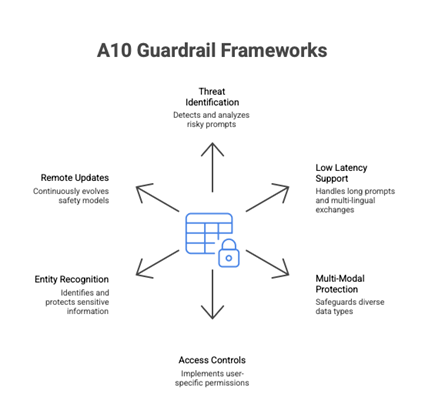
An effective safety framework provides:
- Reasoning-based threat identification: Detecting the reasons and methods behind risky prompts.
- Ultra-low latency and high-concurrency support: Enabling seamless handling of even extremely long prompts (tens of thousands of tokens) and multi-turn, multi-lingual exchanges.
- Multi-modal traffic protection: Safeguarding diverse data types, including audio, video, text, and PDFs.
- Role-based access controls and natural language policy layers: Implementing user-specific permissions and entitlements, customizing guardrail strength based on verticals and applications, and preventing unauthorized model exposures.
- Recognition of over 50 named entity types: Ensuring comprehensive protection for PII and sensitive categories.
- Remote and extensible updates: Continuous evolution and remote deployment of safety and threat detection models, including extensions for AI agents and protocol updates.
Educating the Market on GenAI Threat Parameters
A10 extends prior discussions on AI safety by academia and industry, educating and supporting customers with rigorous benchmarks and real-world parameters for effective AI guardrails, adversarial testing, and policy implementation. Enterprises using our AI security solutions benefit from continuous model evolution, actionable insights, and a future-proof architecture designed to safeguard AI-driven business operations.
A10 AI Security Leadership and Layer 8 Innovation
We have a robust track record in securing top cloud providers and delivering API protection at scale, demonstrating recognized low-latency performance across major data centers. A10’s innovation accelerated with “Layer 8,” which addresses human intent expressed in user prompts and deploys advanced LLM expertise in cybersecurity contexts.